
FREQUENTLY ASKED QUESTIONS
PROJECT DEVELOPMENT
Can I get a loan for my investment project in Bali?
In some cases, it may be possible to obtain a loan in your home country, but we cannot guarantee this. It depends on several factors outside Magnitude Construction’s control.
In Bali, foreigners cannot obtain a loan.
In Bali, foreigners cannot obtain a loan.
Do I need to travel to Bali to start an investment project?
No, you do not need to visit Bali before starting your project with Magnitude Construction. Our system allows you to manage your project remotely. Our specialist team will guide you through every step, including administrative procedures, land selection and architectural approvals.
You will have access to a project space where photos and videos of your property are uploaded every week. Phone or video meetings are also arranged regularly or whenever you need them.
You will have access to a project space where photos and videos of your property are uploaded every week. Phone or video meetings are also arranged regularly or whenever you need them.
What are the main stages of my project, and how long do they take?
Here are the main stages of your project: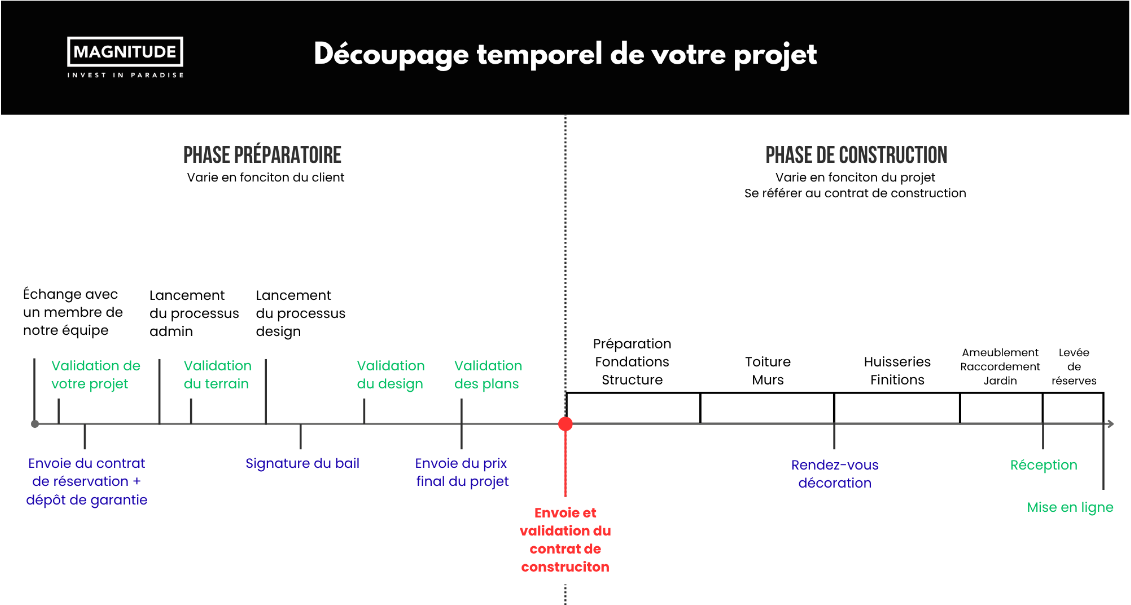
- Meet with a member of our team and define your project
- Sign your project agreement with Magnitude Construction and pay the security deposit
- Begin the administrative procedures, including setting up your PT PMA and its associated bank account
- Select and approve the land
- Begin the design process
- Approve the construction plans and final project price
- Sign the construction contract
- Begin construction
- Start the interior design process, including furnishing and decoration
- Complete finishing work and furnishing
- Take delivery of your property
- Carry out any post-handover corrections
- List your villa
- Receive the various construction permits
What is a PT PMA, and why and how should I set one up?
A PT PMA is an Indonesian company that allows foreign investors to legally establish and own a business in Indonesia.
PT stands for Perseroan Terbatas, meaning a limited liability company. PMA stands for Penanaman Modal Asing, meaning foreign investment.
For a foreigner who wants to conduct business in Indonesia, a PT PMA provides a legal structure, a company registered in Indonesia and, depending on the business activity, the ability to own part or all of the company's capital.
For your investment with Magnitude Construction, you do not need to partner with an Indonesian national. However, your company must have at least two shareholders, who may be individuals and/or legal entities.
In short, a PT PMA is an Indonesian company with foreign capital, designed to allow foreign investors to do business in Indonesia within a legal and structured framework.
Magnitude Construction handles the entire process of setting up your PT PMA.
LAND SELECTION
Leasehold vs. Freehold: what is the difference?
Leasehold is the right to use a property for a fixed period. The investor does not own the land but has the right to use it for the period specified in the lease agreement.
Freehold is full ownership of the land. The investor owns the land and the property built on it, subject to the rules governing property ownership in Indonesia.
Freehold is full ownership of the land. The investor owns the land and the property built on it, subject to the rules governing property ownership in Indonesia.
What checks are carried out during land due diligence?
Due diligence checks whether the land can be acquired and used as intended for your project, and identifies potential risks before you commit.
The following points should be reviewed:
The following points should be reviewed:
- Land ownership: verify the owner's identity and confirm they are legally entitled to sell or lease the land
- Ownership documents: confirm their authenticity, validity and compliance
- Existing charges or restrictions, such as debts, disputes, mortgages or other encumbrances
- Land boundaries and area: ensure the actual dimensions match the official documents
- Access: confirm that access is legal and suitable for the proposed project
- Zoning and land use: check that the intended project is permitted
- Permits and restrictions that apply to construction and operation
- The location, surroundings, topography and any technical constraints
What are the different land zoning categories where we can build?
The main zoning categories are:
- Pink Zone: primarily intended for tourism activities and tourism-related projects
- Yellow Zone: primarily intended for residential areas and housing
- Brown Zone: primarily intended for commercial and economic activities
- Green Zone: intended to preserve agricultural and natural areas; construction is heavily restricted
- LSD (Lahan Sawah Dilindungi): protected agricultural land, including protected rice fields, where construction is very limited or prohibited
Can foreigners own land in Indonesia?
Freehold ownership exists in Indonesia and is known as Hak Milik. However, a foreigner cannot hold Hak Milik directly as an individual. Foreign investors may use other legal structures to hold rights to land, including Leasehold, Hak Pakai or, in some cases, HGB through a PT PMA.
Magnitude Construction can help you choose the structure best suited to your project and protect your investment in Indonesia.
Magnitude Construction can help you choose the structure best suited to your project and protect your investment in Indonesia.
Can a foreigner use an Indonesian nominee to buy land?
Some foreigners use an Indonesian national's name to acquire land under Hak Milik (Freehold). This arrangement is commonly called a nominee or nominee structure.
However, it does not make the foreigner the legal owner of the land. The official owner remains the Indonesian national named on the title certificate.
However, it does not make the foreigner the legal owner of the land. The official owner remains the Indonesian national named on the title certificate.
How do I reserve a plot of land?
After speaking with a member of our team, we will send you a reservation agreement to sign, together with a deposit of €10,000 to confirm your project.
We will then appoint a notary to prepare a notarized deed for you and the landowner to sign. The deed includes the owner's name, the plot's location and area, the lease term, the price and the lease renewal conditions.
We will then appoint a notary to prepare a notarized deed for you and the landowner to sign. The deed includes the owner's name, the plot's location and area, the lease term, the price and the lease renewal conditions.
What happens to the villa at the end of the lease, and what options are available?
At the end of your agreement, if the terms have not been negotiated in advance, you can request a lease extension from the landowner.
If an extension is not possible, the property reverts to the landowner.
If an extension is not possible, the property reverts to the landowner.
Can the landowner refuse a lease extension, and what terms apply when the lease expires?
Yes. The landowner may refuse an extension when the lease expires, unless specific extension terms were included in the original agreement.
An extension is generally subject to negotiation between the parties.
An extension is generally subject to negotiation between the parties.
What permits are required to construct a building?
The main permits include:
- PBG (Persetujuan Bangunan Gedung): a permit to construct, modify, extend or renovate a building in accordance with the applicable plans and technical standards. It must be obtained before construction begins.
- SLF (Sertifikat Laik Fungsi): a certificate confirming that a building complies with applicable standards and is fit for its intended use. It is issued after construction.
- ABT (Air Bawah Tanah): a permit related to the use of groundwater, which may be required when a project involves a well or groundwater extraction.
PBG vs. SLF: what is the difference?
The difference is straightforward:
- PBG = authorization to build
- SLF = certification that the building may be used
Does my villa come with a warranty after construction?
Every completed project comes with two warranties:
- A one-year workmanship warranty covering major construction defects
- A five-year structural warranty, which does not cover force majeure, severe weather, earthquakes, floods, accidents or other natural deterioration of the building
What are the legal and contractual provisions if one of the co-owners dies?
If one of the co-owners dies, their rights are transferred to the last surviving member of their family. That person then becomes responsible for their share and involvement in the project.
As inheritance arrangements may vary depending on family and legal circumstances, we recommend consulting a notary in advance to clarify succession rights and ensure they are properly transferred.
As inheritance arrangements may vary depending on family and legal circumstances, we recommend consulting a notary in advance to clarify succession rights and ensure they are properly transferred.
TAXATION
What taxes apply to companies in Indonesia?
Depending on the type of project, three types of tax may apply in Indonesia:
- Hotel and Restaurant Tax (Pajak Hotel dan Restoran – PHR): 10% of revenue generated by accommodation and restaurant activities
- Corporate Income Tax (PPh): 11% of the company's taxable profit, calculated as revenue less deductible expenses
- Dividend withholding tax: between 10% and 15%, depending on the shareholder's country of tax residence and any applicable tax treaties
How are French investors in Bali taxed?
The personal tax treatment of a French investor, or an investor of any other nationality, depends on many factors, including tax residence, personal and family circumstances, income and investment structure.
There is no general answer that applies to every investor. We recommend consulting your accountant or tax advisor for an assessment tailored to your situation and to ensure you meet your tax obligations both in your home country and in Indonesia.
There is no general answer that applies to every investor. We recommend consulting your accountant or tax advisor for an assessment tailored to your situation and to ensure you meet your tax obligations both in your home country and in Indonesia.
RENTAL MANAGEMENT
How is my property managed as a rental?
We work with Bali SuperHost to provide full rental management for your property. They handle all aspects, including financial management, cleaning, maintenance, guest reception and more, giving you a hassle-free rental management solution.
I want to rent out my property, but I am worried that guests might damage my villa. What can you do?
A team is always available to manage guest check-ins and check-outs and monitor the villa's condition. Any damage caused by guests is their responsibility, so you can rent out your villa with peace of mind.
How much are the monthly management fees?
For a clearer picture of the costs involved in managing your property, please see our case studies, which provide detailed examples.
View our case studies
View our case studies